Local Expert
Moving to St. Augustine, FL: What to Know Before You Relocate
Ben Cote • July 19, 2026
Thinking about moving to St. Augustine, FL? Here's an honest relocation guide — the neighborhoods, what homes actually cost, flood zones and insurance, and how to figure out which part of the oldest city in America is right for you.
Moving to St. Augustine, FL: What to Know Before You Relocate
By Ben Cote | NE Florida Realtor | eXp Realty
What You'll Learn From This Post
- What St. Augustine is actually like to live in — not just visit
- The distinct areas and neighborhoods, from historic downtown to the beaches
- What homes actually cost across different parts of the city
- What the schools are like and how zoning actually works
- The honest tradeoffs: insurance, flood zones, tourist traffic, and commuting
- A first 30 days relocation checklist
- Who St. Augustine is right for — and how to figure out where you fit
Most people know St. Augustine as a place they visited once. The oldest city in America. Cobblestone streets, Spanish forts, ghost tours, a weekend trip they still remember.
Far fewer people think of it as a place to actually live.
They should.
My family relocated to Northeast Florida from Vermont, and St. Augustine quickly became one of the defining reasons we love where we landed. It's not just a destination we drive to on weekends. It's a genuine, livable, layered city with real neighborhoods, real character, and a real sense of place that's increasingly hard to find.
If you're considering a move to St. Augustine, here's the honest guide — what it's actually like, what it costs, and how to figure out where you belong.
First, Understand This: St. Augustine Isn't One Lifestyle
This is the single most important thing to understand before you start your search.
St. Augustine is not a single, uniform place. It's a collection of very different lifestyles stacked into one area — and where you live shapes how you live more than almost anywhere else in Northeast Florida.
You can live in a 200-year-old cottage in a walkable historic district. You can live barefoot near the beach on a barrier island. You can live in a brand-new master-planned community with resort amenities fifteen minutes from downtown. You can live on quiet mainland streets with mature oaks and lower costs.
All of it is "St. Augustine." None of it feels the same.
The biggest mistake relocating buyers make is assuming one "best neighborhood" list applies to them. It doesn't. The right area depends entirely on your budget, your stage of life, your commute, and the kind of daily life you actually want.
Let's break down the main areas.
The Historic District and City Neighborhoods
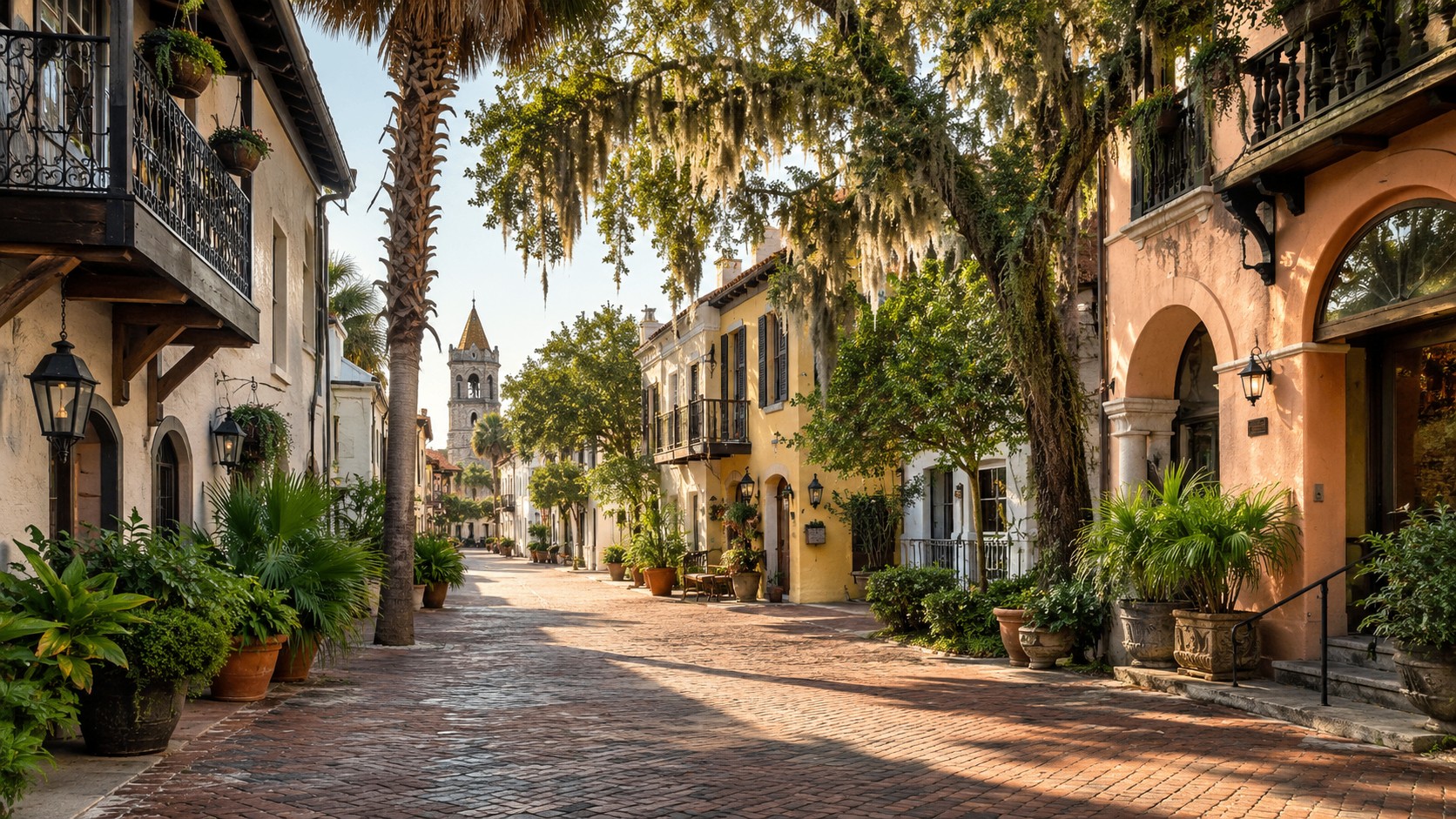
This is the St. Augustine everyone pictures. Brick-lined streets, Spanish colonial architecture, Spanish moss, and centuries of history in every block.
The city district includes Historic Downtown along with surrounding neighborhoods like Lincolnville, Uptown, Fullerwood Park, Nelmar Terrace, and Davis Shores. Homes here tend to be cottages, Queen Anne, and Frame Vernacular styles — many with front porches, deep character, and real age.
Lincolnville deserves special mention. Founded in 1866 by formerly enslaved people, it's St. Augustine's oldest historically Black neighborhood — a 45-block historic district on the National Register of Historic Places. Today it's an eclectic, walkable, tree-lined area with a genuine arts scene, local breweries, and community events like Porch Fest that bring neighbors together.
Who it's for: Buyers who want walkability, character, culture, and history over square footage and newness. People who want to walk to dinner, live among architecture that can't be replicated, and be in the heart of everything.
The tradeoff: Older homes mean older-home maintenance. Historic districts often come with preservation guidelines. And you'll pay a premium for location and character, especially near the water.
The Beaches and Barrier Islands
If your dream is coastal living, this is where you look.
Anastasia Island sits just across the Matanzas River from downtown — a barrier island that's a haven for beach lovers and outdoor enthusiasts. It's home to Anastasia State Park's 1,600 acres of dunes, trails, and salt marsh, the St. Augustine Lighthouse, and the St. Augustine Amphitheatre. Housing ranges from beachfront homes with ocean views to midcentury bungalows on quiet streets. The island is also served by highly rated schools including R.B. Hunt Elementary.
St. Augustine Beach, on Anastasia Island, is a lively beach community with wide sandy beaches, a beachfront park, and a genuine local-meets-visitor energy.
Vilano Beach, to the north on a long thin peninsula, has a quieter, more laid-back, retro character — Art Deco details, a community feel, and the best of both worlds with the sheltered Tolomato River on one side and the Atlantic on the other.
Who it's for: Buyers who want beach access, outdoor living, and a coastal lifestyle as the center of daily life.
The tradeoff: Coastal proximity means paying close attention to flood zones and insurance costs — more on that below. It matters more here than almost anywhere.
The Master-Planned Communities West of Downtown
For families relocating from out of state, this is often where the search lands — and for good reason.
West of downtown and west of I-95, communities like World Golf Village, Palencia, Beacon Lake, and the broader St. Johns County master-planned communities offer newer construction, resort-style amenities, strong neighborhood planning, and access to top-rated schools. These communities deliver the "full Florida lifestyle" that a lot of relocating families are picturing — pools, trails, golf cart paths, and built-in social connection.
Palencia in particular offers a blend of luxury and convenience in a coastal setting between St. Augustine and Jacksonville, and consistently ranks among the area's premier family communities.
Who it's for: Families who want newer homes, amenities, top schools, and a faster path to community — especially those relocating from out of state who want an easier social transition.
The tradeoff: These communities typically carry HOA fees and, in many cases, CDD assessments — a real recurring cost worth understanding fully before you buy. (I've written a full breakdown of how CDD fees work if you want to understand exactly what you'd be paying for.)
The Value Play: Mainland Neighborhoods
Not every relocating buyer wants amenities and fees. For buyers who want more flexibility and lower ongoing costs, established mainland neighborhoods like St. Augustine Shores and St. Augustine South offer real value.
St. Augustine Shores, for example, offers golf, tennis, walking paths, community lakes, and the Riverview Club for events — without the fee structure of a newer master-planned community. Mature trees, established streets, and more accessible price points make these areas practical choices for a lot of buyers.
Who it's for: Buyers who want value, flexibility, and lower recurring costs, and who don't need brand-new construction or extensive resort amenities.
The Schools: What Relocating Families Actually Want to Know
For a lot of families, this is the section that matters most — and it's one of the biggest reasons people move to the St. Augustine area specifically.
The entire region is served by the St. Johns County School District, which is consistently ranked the top public school district in Florida. For the 2025-2026 school year, the district earned 40 "A" schools, 5 "B" schools, and just 1 "C" school. It ranked first in the state in reading across multiple grade levels. Across roughly 52,000 students district-wide, state test scores show about 77% proficiency in math and 75% in reading — well above state and national averages. On Niche, the district holds an overall "A" grade.
That district-wide strength is the headline. But when you're buying a specific home, what actually matters is the attendance zone that home falls into — because St. Augustine has a mix of long-established schools and brand-new ones.
A few of the high schools serving the St. Augustine area:
St. Augustine High School — the oldest active high school in the district, home to the Yellow Jackets, with established arts, aerospace, JROTC, and law academies. Its attendance boundary includes Vilano Beach and much of the St. Augustine area.
Pedro Menendez High School — south of the city off State Road 206, serving the southern St. Augustine area on a large rural campus.
Tocoi Creek High School — a newer school that opened in 2021 on the growing west side, serving the rapidly developing communities off St. Johns Parkway.
Beachside High School — one of the district's newest, opened in 2022, serving the northern St. Johns corridor.
On the coast, Anastasia Island families are often zoned for highly rated schools including R.B. Hunt Elementary.
The single most important thing to understand: attendance boundaries are assigned by address, and in a fast-growing county, those boundaries change. A home you're considering may be zoned for a different school than the one down the street — and rezoning happens as new schools open to handle growth. Never assume a home's school assignment based on the neighborhood name or proximity. Always verify the current zoning for the specific address directly with the district before you make an offer. It's one of the first things I check for any family buying with schools as a priority.
What Homes Actually Cost
Let's talk real numbers.
The median single-family home price in St. Augustine sits around $516,000 — higher than the national average. Historic District and waterfront properties command a premium, while homes north and west of downtown are generally more accessible.
For families targeting the full lifestyle with newer construction and strong school zones, the $500,000 to $750,000 range is where much of the relocation search happens. More accessible neighborhoods and starter options exist below that, and luxury coastal and historic properties climb well above it.
Worth understanding: St. Johns County home prices run meaningfully higher than neighboring Jacksonville — with county median prices in the $450,000 to $500,000 range compared to Jacksonville's lower figures. That premium isn't accidental. It reflects the top-ranked school district, coastal access, and a community character that sustains demand from buyers who specifically want what St. Augustine offers.
The Honest Tradeoffs
I'm not here to sell you a postcard. Here's what you actually need to weigh.
Insurance and flood zones. This is the big one in St. Augustine. Coastal and low-lying areas carry flood risk, and homeowner's insurance plus flood insurance where applicable is a real, significant cost. Always verify the flood zone designation of any specific property before you fall in love with it — it materially affects your monthly cost of ownership.
Property taxes. St. Johns County's higher assessed values mean property taxes here run higher than some neighboring counties. The tradeoff is what those taxes fund — the top-ranked schools and quality of life the county is known for.
Tourist traffic. St. Augustine is a major tourist destination. In the historic district and around the beaches, that means seasonal crowds, traffic, and a different rhythm than a purely residential area. For some people the energy is a feature. For others it's something to plan around by choosing where you live carefully.
Summer heat and hurricane season. Same as all of Northeast Florida — summers are hot and humid, and hurricane season runs June through November. It's manageable and worth it, but it's honest to name it.
Jobs and commuting. St. Augustine's local economy centers on tourism, healthcare, retail, and education. Many professional and corporate roles require commuting to Jacksonville, roughly 45 minutes north — a drive a lot of residents make daily. Remote workers have increasingly made St. Augustine home for exactly this reason.
Your First 30 Days: A Relocation Checklist
Once you've closed and the moving truck pulls away, the move isn't quite done. Here's a practical checklist for settling into St. Augustine and St. Johns County — the things that are easy to forget in the chaos of a long-distance move.
Establish Florida residency. File for the homestead exemption on your primary residence through the St. Johns County Property Appraiser — it can meaningfully lower your property tax bill, and there are deadlines that matter.
Get your Florida driver's license and registration. Florida generally requires new residents to obtain a license and register vehicles within 30 days of establishing residency. Handle this early to avoid the rush.
Confirm your school zoning and enroll. If you have kids, verify the attendance zone for your specific address with the St. Johns County School District and complete enrollment. Have records and immunizations ready.
Set up utilities and services. Electric, water, internet, and trash pickup. In many master-planned communities, some of these are coordinated through the community — worth confirming what's included.
Review your insurance. Confirm your homeowner's policy is active and that you understand your flood zone status and any flood insurance requirements. If you haven't already, this is the moment to make sure there are no gaps.
Register to vote and update your address. Update your address with USPS, your bank, your employer, and the IRS, and register to vote in St. Johns County.
Find your essentials. Establish a primary care doctor, a pediatrician if you have kids, a dentist, and a vet if you have pets. In a fast-growing county, some practices have waitlists, so start early.
Then — go explore. Drive to St. Augustine Beach. Walk St. George Street. Find your coffee shop, your grocery store, your favorite spot on the water. The paperwork gets you settled. Actually living here is what makes it home.
So Who Is St. Augustine Right For?
If you want history, walkability, and genuine character — the historic district and city neighborhoods deliver something you cannot find in a new build anywhere.
If you want the beach as your daily life — Anastasia Island, St. Augustine Beach, and Vilano Beach put you there.
If you want newer construction, amenities, and top schools with an easier relocation transition — the master-planned communities west of downtown are built for you.
If you want value and flexibility without the fees — the established mainland neighborhoods are worth a serious look.
The common thread: St. Augustine offers something increasingly rare — a real sense of place. History, coastline, modern convenience, top schools, and a character that draws people who specifically want what this city is, rather than settling for it as an affordable alternative to somewhere else.
That's a rare combination. And it's why people who visit once so often end up researching the move.
If you're thinking about relocating to St. Augustine and want help matching your budget, your goals, and your lifestyle to the right part of the city, that's exactly the kind of conversation I have with families every week. I relocated my own family to Northeast Florida from a thousand miles away — I know what it's like to figure this out from scratch.
👉 thecotecollective.com/relocate
Ben Cote | NE Florida Realtor | eXp Realty | 802.734.2397