Real Estate Education
Master-Planned Community: The Term Everyone Uses and Nobody Explains.
Ben Cote • June 22, 2026
Master-planned community comes up in every Northeast Florida search. Here's the honest breakdown — what they actually are, the real pros and cons, what CDD fees cost, and who they're actually right for.
Master-Planned Community: The Term Everyone Uses and Nobody Explains.
By Ben Cote | NE Florida Realtor | eXp Realty
What You'll Learn From This Post
- What actually makes a community "master-planned" versus a regular neighborhood
- Why these communities have become so popular with relocating families
- The genuine pros — and the honest cons
- What CDD and HOA fees actually pay for and what they typically cost
- Who thrives in a master-planned community — and who might be happier elsewhere
- What to actually check before you buy
If you've spent any time researching a move to Northeast Florida, you've heard the term constantly. Master-planned community. It gets used in every listing, every YouTube tour, every Facebook group thread.
But most people never get a straight answer on what it actually means.
Here's the honest breakdown — what these communities are, why they've become so popular, where they fall short, and how to figure out if one is actually right for you.
What is a CDD fee in Florida?
A CDD (Community Development District) fee is a non-ad valorem assessment that funds the roads, drainage, utilities, and amenities in a master-planned community. It's created under Florida law (Chapter 190) and shows up as a separate line item on your property tax bill — not part of your home's assessed value.
How much are CDD fees in St. Johns County?
CDD fees vary by community and even by phase within the same community, typically running $1,000–$3,500+ per year. Some newer or amenity-heavy sections can run higher. Always confirm the exact district and fee tied to the specific address, not just the community name.
Is a CDD fee the same as an HOA fee?
No. A CDD fee repays public infrastructure bonds and is collected through your property tax bill by the county. An HOA fee is a private assessment covering community rules enforcement and day-to-day upkeep. Most master-planned communities in St. Johns County have both.
Does the CDD fee ever go away?
The debt-service portion (paying off the infrastructure bonds) typically ends after 20–30 years. The operations-and-maintenance portion continues indefinitely as long as the district exists.
What a Master-Planned Community Actually Is
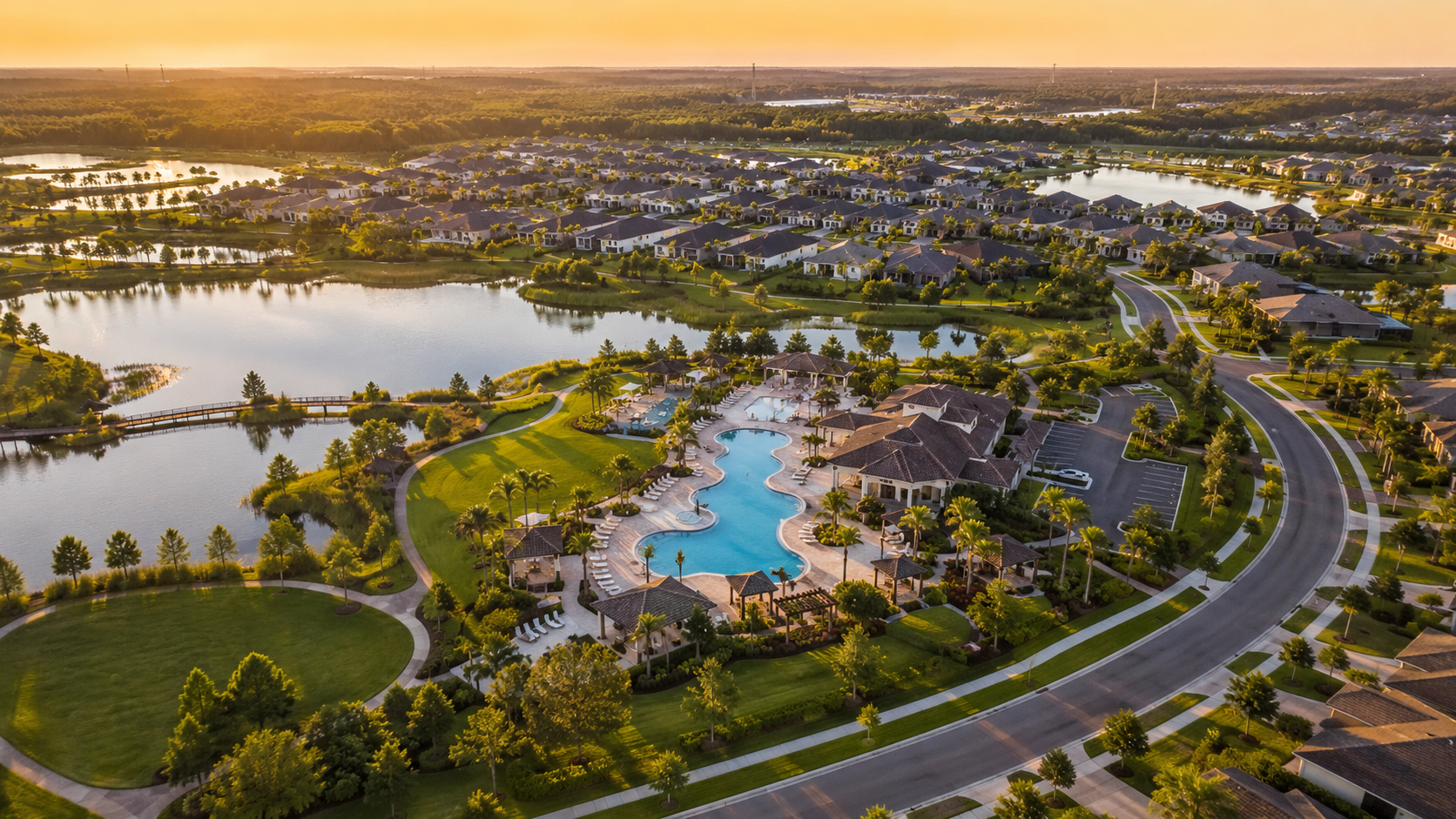
A master-planned community is a large-scale residential development built from a single, comprehensive design — planned in advance by a developer rather than growing organically over time like a traditional neighborhood.
That's the key difference. A regular subdivision is usually just homes on lots, built by one or several builders, with maybe a shared entrance sign and not much else coordinating the whole thing. A master-planned community is designed as a complete environment from day one — roads, drainage, parks, schools sites, retail, amenities, and housing all planned together as a single, cohesive system, often built out over many years in phases.
In Northeast Florida, names like Nocatee, Rivertown, Shearwater, SilverLeaf, and World Golf Village are all master-planned communities. They can span thousands of acres, take a decade or more to fully build out, and ultimately house tens of thousands of residents.
Why the Hype Is Real
There's a reason these communities dominate relocation searches and continue to grow in popularity. The draws are genuine.
Amenities most neighborhoods simply can't offer. Resort-style pools, water parks, fitness centers, sports courts, miles of trails, kayak launches, dog parks, splash pads. A master-planned community can fund and build amenities at a scale that a typical subdivision never could — because the infrastructure was planned and financed for thousands of homes from the start.
Built-in community. These developments are often full of transplants — families relocating from out of state, all in similar life stages, all looking for the same thing. Meeting people tends to happen faster and more naturally than in an established neighborhood where social circles are already set.
Consistency and design. Streetscapes are intentional. Landscaping is maintained. Architecture often follows a cohesive style. For a lot of buyers, that consistency is part of the appeal — there's a predictability to how the community looks and feels, today and years from now.
Golf cart culture. Many Northeast Florida master-planned communities are fully golf cart friendly, with dedicated paths connecting homes to schools, shopping, and amenities. It's a lifestyle shift that's hard to overstate once you've lived it.
Top school zoning, often by design. Developers frequently build or partner with school districts to place new schools directly inside the community — meaning kids may be zoned for brand new facilities within walking or golf cart distance of home.
These are real, tangible benefits. They're a major reason families relocating to Northeast Florida gravitate toward these communities specifically.
The Honest Cons
This is where balance matters — because these communities aren't the right fit for everyone, and it's worth knowing the tradeoffs before you commit.
CDD fees. This is the one that catches the most buyers off guard. A Community Development District, or CDD, is a special-purpose local government created under Florida law that finances and maintains community infrastructure — roads, drainage, parks, and major amenities — through bonds. Those bonds get repaid through an annual assessment that shows up on your property tax bill as a separate line item.
In St. Johns County, CDD fees on master-planned communities typically run somewhere in the range of $1,200 to $3,500 per year, though the exact amount varies significantly by community, by phase, and even by specific lot within the same neighborhood. Some communities — like SilverLeaf — have no CDD at all and fund amenities through the HOA instead. Others, like Nocatee, use multiple CDDs across different sections of the development.
CDD fees are not optional and they are not the same as HOA dues. They fund real infrastructure — the roads you drive on, the parks you use, the lakes that manage stormwater — and they're part of why these communities can offer the amenities they do. But they add a real, recurring cost on top of your mortgage, property taxes, and any HOA fees. Always get the exact CDD figure for a specific home before making an offer — never assume based on community marketing alone.
HOA fees and rules. On top of any CDD, most master-planned communities also have an HOA — a private association that manages community standards, enforces architectural guidelines, and maintains common areas. HOA dues are a separate, additional cost. And HOA rules can be restrictive — paint colors, landscaping requirements, what you can park in your driveway, whether you can put up a fence. For some buyers that consistency is a feature. For others it feels like a loss of control over their own property.
Combined recurring costs add up. Between CDD fees, HOA dues, and property taxes, the true monthly cost of owning in a master-planned community can be meaningfully higher than an equivalent home in a non-CDD neighborhood — even at the same purchase price. It's important to calculate total cost of ownership, not just compare sale prices.
Less individuality. Master-planned communities tend to have a cohesive, sometimes uniform feel. If you're someone who wants an eclectic, historic, or one-of-a-kind property — a master-planned community is probably not going to scratch that itch.
It can feel manufactured. Some buyers tour a master-planned community and find the design intentional in a way that feels more like a destination than a neighborhood. That's a completely valid reaction. It's not the right feel for everyone.
Scale can be overwhelming. Some of the larger master-planned communities in Northeast Florida span thousands of acres and tens of thousands of residents. For buyers who want a smaller, quieter, more intimate setting, that scale can feel like a lot.
Who Thrives in a Master-Planned Community
Families with young kids who want amenities, built-in social opportunities, and top-tier school zoning all in one place. People relocating from out of state who want a faster path to community and connection. Buyers who value low-maintenance, well-managed common areas and don't mind paying for it. People who want golf cart living, walkable amenities, and a predictable, well-designed environment.
Who Might Be Happier Elsewhere
Buyers who want land, privacy, or space between neighbors. People who dislike HOA oversight or want full control over their property's appearance. Buyers drawn to historic districts, eclectic architecture, or established neighborhoods with organic character. People who are cost-sensitive about recurring fees and want to minimize ongoing housing costs beyond the mortgage. Buyers who prefer a smaller, quieter setting over a large-scale, amenity-rich environment.
What to Actually Check Before You Buy
Before making an offer in any master-planned community, get clear answers on these:
The exact CDD assessment for the specific parcel — not a community average. Whether the CDD has both a debt-service portion and an operations and maintenance portion, and how many years remain on the bond.
The HOA's current budget, reserve fund, and any planned special assessments.
What the CDD funds versus what the HOA funds — they're often different entities covering different things, and overlap is common but shouldn't mean double-paying for the same service.
Whether the community has one CDD or multiple CDDs across different phases — larger communities often do, and rates can differ by section.
The total combined monthly cost — mortgage, property taxes, CDD, and HOA together — not just the listing price.
A good agent will walk you through all of this before you write an offer, not after.
The Bottom Line
Master-planned communities have become the dominant choice for relocating families in Northeast Florida for real reasons — amenities, community, schools, and lifestyle that are difficult to replicate elsewhere. But they come with real costs and real tradeoffs that deserve honest consideration, not just brochure enthusiasm.
The right answer depends entirely on what you value. Some families want the amenities and community enough that the fees are an easy trade. Others would rather have more space, more privacy, and fewer recurring costs — even if it means a quieter, less amenity-driven lifestyle.
Both are valid. The goal is making the choice with clear eyes, not just following the hype.
Have questions about CDD fees, HOA structures, or which type of community actually fits your goals? That's exactly the kind of conversation worth having before you start touring homes.
👉 thecotecollective.com/relocate
Ben Cote | NE Florida Realtor | eXp Realty | 802.734.2397