Local Expert
A $430 Million Jet Factory Is Coming to Jacksonville — And It Says Something Bigger About the Region
Ben Cote • August 18, 2026
Otto Aerospace is relocating its headquarters to Jacksonville and building a $430 million jet factory at Cecil Airport — with $90K-average jobs. Here's what it means for Northeast Florida's job market and anyone thinking about the move.
A $430 Million Jet Factory Is Coming to Jacksonville — And It Says Something Bigger About the Region
By Ben Cote | NE Florida Realtor | eXp Realty
What You'll Learn From This Post
- What Otto Aerospace is building at Jacksonville's Cecil Airport
- The real numbers: investment, jobs, wages, and timeline
- Why an aerospace manufacturer chose Jacksonville over everywhere else
- What this signals about the Northeast Florida job market
- Why it matters if you're relocating and worried about career opportunity
When people picture Florida, they picture beaches and retirees. Sunshine and golf carts. A place you go to relax, not a place you go to build a career.
That picture is increasingly out of date — and stories like this one are why.
A next-generation aircraft manufacturer is relocating its headquarters to Jacksonville and building a $430 million production facility here. It's the kind of high-wage, high-tech investment that reshapes what a region's economy is built on. And for anyone relocating to Northeast Florida who's quietly wondering whether there's real career opportunity here — not just service jobs and tourism — it's worth understanding what's happening.
What's Actually Being Built
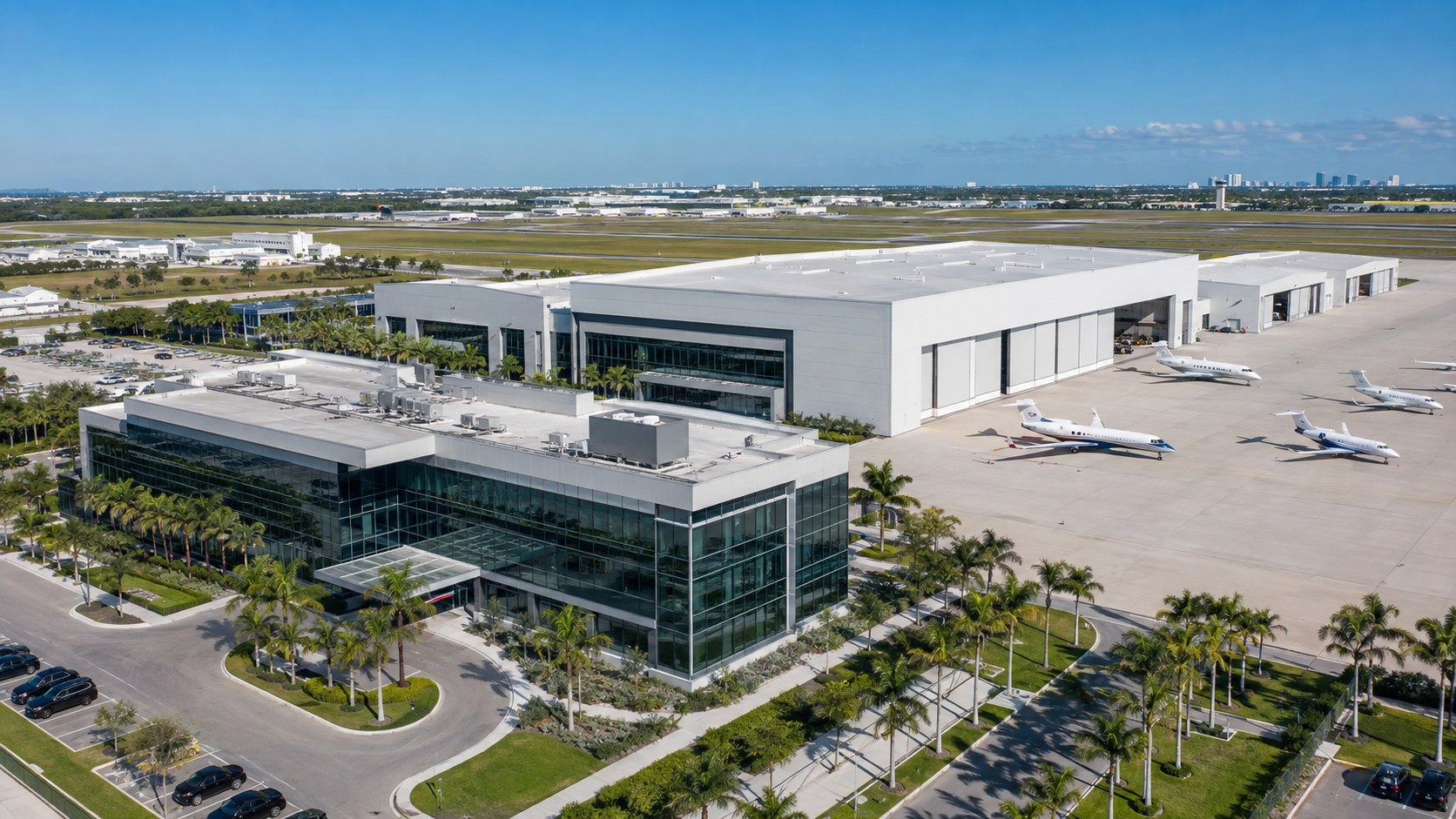
Otto Aerospace — a Texas-based aircraft manufacturer previously known as Otto Aviation — is relocating its corporate headquarters from Fort Worth to Jacksonville and establishing a major manufacturing operation at Cecil Airport on the city's west side.
The company will invest up to $430 million across two phases. It's the largest investment and potential job creator for any new development or tenant in the history of the Jacksonville Aviation Authority.
The facility will be the primary site for final assembly of the Phantom 3500 — Otto's next-generation business jet. And the aircraft itself is genuinely innovative: it uses a full laminar flow design that cuts aerodynamic drag by about 35% compared to traditional jets, allowing it to fly farther on dramatically less fuel, with a range of 3,500 nautical miles and a cruise altitude of 51,000 feet.
The plan rolls out in two phases:
Phase one has Otto moving into Hangar 825, an existing hangar at Cecil Airport originally built by the U.S. Navy and more recently used by Boeing. This lets the company get operational relatively quickly.
Phase two is the big build — a campus spanning roughly 80 to 100 acres, with more than 600,000 square feet of office and manufacturing space, multiple new buildings, three hangars, and a custom jet showroom. Construction of the new facility is expected to begin in 2027.
Production of flight-test vehicles is slated to begin in 2026, with flight testing following in early 2027 and aircraft certification and market entry targeted for 2030.
The Numbers That Actually Matter
Here's where it gets meaningful for the region.
The project is expected to create at least 400 jobs by the end of 2031, at an average salary around $90,000 — with potential expansion to as many as 1,200 jobs by 2040 as the operation scales.
Sit with that average salary figure for a second. $90,000 is well above the median household income for the area. These aren't service or seasonal jobs — they're skilled manufacturing and engineering positions, the kind that anchor a middle and upper-middle class and tend to bring other high-wage employers with them.
To land it, the community put real skin in the game: the Jacksonville Aviation Authority approved a $34.9 million incentive package, and the City of Jacksonville approved up to $20 million in a revenue-based grant. Cities don't compete that hard for employers they consider marginal. They compete like that for anchor tenants they believe will reshape the local economy.
Why Jacksonville Won
This is the part that tells you something bigger.
Otto looked at locations across Florida and beyond, and Jacksonville stood out. Local economic development leaders pointed to one deciding factor in particular: the availability of hangar space at Cecil Airport gave Jacksonville a head start nowhere else could match. Cecil — a former Navy base the Aviation Authority took over in 1999 — has been quietly built up over decades into exactly the kind of aviation infrastructure a company like Otto needs.
And local officials aren't treating this as a one-off. The stated vision is to use Otto as an anchor to turn Cecil Airport into a genuine aerospace hub — attracting more aviation, aerospace, space, and defense companies over the next decade. When you land one marquee manufacturer, suppliers, engineers, and related businesses tend to follow. That's how industry clusters form, and it's how a regional economy diversifies and strengthens over time.
Why This Matters If You're Relocating
Here's the honest reason this belongs on a relocation blog.
One of the quiet fears families have about moving to Florida — especially working-age families relocating from the Northeast — is career opportunity. Will there be real jobs here? Or is it all hospitality, retail, and retirement services? For a household where one or both spouses need strong professional employment, that question isn't small. It can be the whole decision.
Investments like this one are the answer. A $430 million advanced-manufacturing headquarters with $90,000 average salaries is a signal — not just about one company, but about the direction of the entire regional economy. It's the same story told by the University of Florida's new graduate campus downtown, by the thousands of healthcare jobs expanding across St. Johns County, and by the billions flowing into Jacksonville's core.
The picture that emerges is a region diversifying beyond tourism into aerospace, healthcare, education, technology, and advanced manufacturing. That diversity is what makes a job market resilient — and what makes relocating here a sound long-term bet rather than a lifestyle gamble.
You're not trading your career for sunshine. Increasingly, you can have both.
The Bigger Picture
A single jet factory doesn't transform an economy overnight. Timelines can shift, job numbers ramp up over years, and the full campus is still to be built.
But the direction is unmistakable. Northeast Florida keeps attracting exactly the kind of high-wage, high-skill investment that builds a durable economy — and it keeps winning these competitions against other regions. For families weighing a move, that's the context that matters. This isn't a place that's finished growing. It's a place that's still being built — and increasingly, being built around good jobs.
If you're relocating to Northeast Florida and thinking through not just where to live but what the long-term opportunity looks like, that's exactly the kind of bigger-picture conversation I have with families every week.
👉 thecotecollective.com/relocate
Ben Cote | NE Florida Realtor | eXp Realty | 802.734.2397